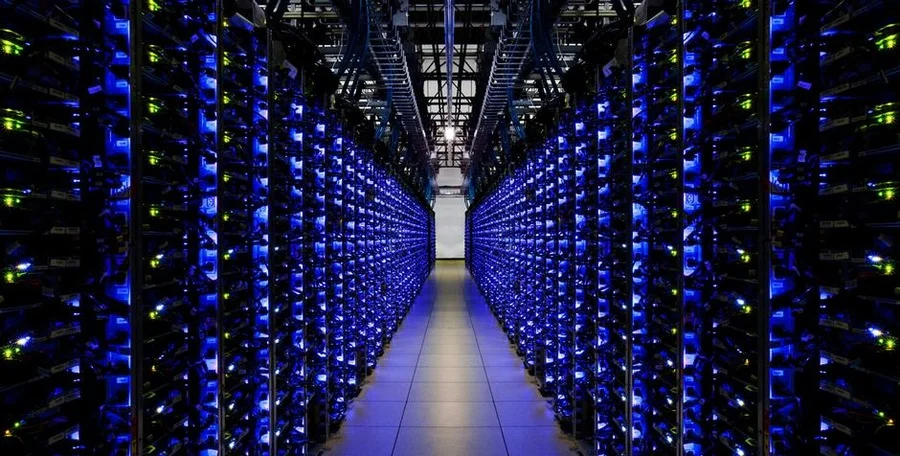
The rapid expansion of data centers, driven by burgeoning artificial intelligence (AI) demand, is significantly amplifying their data center environmental impact. These crucial digital hubs, found worldwide from Virginia to Sao Paulo, consume vast amounts of energy, water, and land. Consequently, they are placing immense pressure on power grids, depleting vital water supplies, and reshaping local environments.
Data centers have become some of the world’s fastest-growing electricity consumers. For example, in Frankfurt, data centers consume approximately 41% of the city’s power. Dublin experiences double that figure. The International Energy Agency predicts global data center electricity consumption will double by 2030, reaching about 945 terawatt-hours, comparable to Japan’s annual usage. Researchers indicate that if data centers were a country, their electricity use would rank them as the 11th largest consumer globally.
This surging power demand often increases reliance on fossil fuels. A 2024 study found that over half of U.S. data centers run on fossil fuels, emitting more than 105 million tons of CO2. Offsetting this would require over 31,000 wind turbines operating continuously for a year. Furthermore, utilities in the U.S. have delayed the retirement of 15 coal-fired plants, which together emitted nearly 65 million tons of greenhouse gases in 2023. More than 100 gigawatts of new gas-fired power plants are also planned nationwide, promising additional carbon emissions.
While renewable energy can power data centers, it creates a new challenge. Green electricity used by data centers becomes unavailable for electrifying transport or decarbonizing other heavy industries. Therefore, this shift has broader implications for climate progress.
Meanwhile, data centers consume millions of gallons of water for cooling. Servers generate constant heat, and water evaporation is highly effective at dissipating it. A single large facility can use up to 5 million gallons daily, equivalent to a town of 10,000 to 50,000 people. Notably, about 80% of this water evaporates; the remainder, as wastewater, can overwhelm local treatment systems. In northern Virginia, nearly 300 data centers collectively used almost 2 billion gallons of water in 2023. Fortunately, more efficient cooling methods, like immersion cooling and closed-loop systems, can reduce freshwater use by up to 70%.
Cooling systems also release significant heat into surrounding areas. This exacerbates the urban heat island effect, making cities hotter than rural areas. Researchers in Phoenix, Arizona, observed that one large data center can emit as much waste heat as hundreds of thousands of households, raising nearby land temperatures by up to 9 degrees Celsius. This elevated heat increases stress risks for residents and boosts air conditioning demand, requiring even more energy. Some data centers are now capturing this waste heat for district heating, potentially reducing their power demand by 30%.
Air pollution presents another critical concern. Both coal and gas power plants release toxic particulate matter, leading to respiratory and heart diseases. Additionally, on-site diesel generators, used for backup power, emit 200 to 600 times more nitrogen oxides than natural gas plants. One estimate suggested that backup generators for all Virginia’s data centers, operating at just 10% of permitted levels, could contribute to 14,000 asthma cases and over a dozen deaths annually, costing up to $300 million in public health expenses.
Finally, data center construction requires extensive land. Repurposing natural and agricultural areas for industrial zones threatens biodiversity and disrupts local ecosystems. For instance, in Hattersheim, Germany, an 18-acre agricultural parcel was rezoned in 2024 for a five-building data center campus. The environmental damage often extends beyond the site, as new gas pipelines and power plants further fragment habitats and erode soil.