The return of convicted war criminal Ratko Mladic’s body to Serbia has reignited deep divisions within the nation. Mladic, the former Bosnian Serb army commander, died last week in The Hague. He was serving a life sentence for genocide and other war crimes.
His coffin, draped in the Serbian flag, arrived back in Serbia. Members of the Serbian Armed Forces transported his remains from the plane to the Military Medical Academy for autopsy. Along the route from the airport, several groups of citizens gathered. They held banners proclaiming “Thank you, General” and “Heroes never die,” greeting the motorcade.
Pro-government tabloids provided extensive coverage. These outlets referred to Mladic as a “Serbian general.” Some even controversially claimed he had been “killed in The Hague.”
Mladic received a life sentence in 2017 from the International Criminal Tribunal for the former Yugoslavia. His conviction included the genocide in Srebrenica, where over 8,000 Muslim men and boys were killed. He was also found guilty of the years-long siege of Sarajevo and other war crimes during the 1992–95 Bosnian War.
Belgrade media reported Mladic’s burial is scheduled for Monday. Previously, Justice Minister Nenad Vujic had announced a funeral with full state honors. However, Serbian President Aleksandar Vucic stated the decision would rest with Mladic’s family.
Security agencies estimate tens of thousands could attend the funeral. President Vucic pledged logistical and transport support. He also promised to maintain public order and security, though he acknowledged the difficulty of ensuring everyone’s safety.
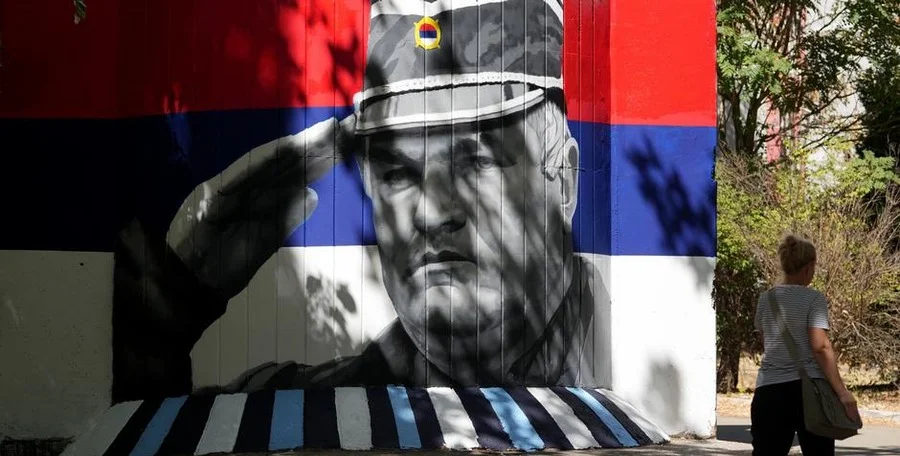
Jasmina Lazovic, executive director of the Belgrade-based Humanitarian Law Center, notes this situation is unsurprising. She highlights the long-standing glorification of Ratko Mladic in Serbia. Murals honoring him exist in many towns. Moreover, a pervasive narrative suggests he was unjustly convicted, now claiming he was killed despite dying at 85 after multiple strokes.
These narratives serve the state leadership, Lazovic explains. They portray Serbia as a nation that fought only defensive wars. This approach unfortunately ignores the wars’ consequences and countless victims. Hundreds of thousands of victims suffered across Croatia, Bosnia and Herzegovina, and Kosovo. These were predominantly crimes against civilians, which dramatically altered the ethnic structure of the region, especially in Bosnia and Herzegovina. Victims include survivors of rape, torture, and forced displacement.
The announcement of potential state honors drew sharp international criticism. European Commissioner for Enlargement Marta Kos stated, “Glorification of war criminals is contrary to European values.” She emphasized its unsuitability for EU member states or candidate countries.
President Vucic responded by accusing the West and the Hague Tribunal of bias. He claimed they blamed only Serbs for war crimes while neglecting Serbian victims. Nevertheless, he officially deferred the state honors decision to Mladic’s family.
Lazovic predicts Vucic will adopt a pragmatic stance. The final decision will likely weigh political benefit against potential damage. She further emphasizes a crucial legal aspect. Under Serbian law, anyone sentenced to over a year in prison loses their rank and associated privileges. Therefore, a state funeral with full military honors would directly violate national law. The debate over a state funeral thus exposes these deep divisions.
Serbian citizens in multi-ethnic Vojvodina express widely differing views. Some firmly believe Mladic was unjustly convicted, asking, “What was he supposed to do, let them kill all the Serbs?” Others, however, accept the genocide verdict. Many residents simply express apathy, stating they have “enough of [their] own problems” or view it as “just another political issue.” Lazovic believes this widespread apathy represents a greater problem. She argues that confronting Mladic’s legacy and the past is essential for Serbian society’s progress.